
6 February 2026
We live convinced that our economic decisions are entirely personal. We buy because we want to, postpone because we fear, and invest because we aspire. Yet reality is calmer and far more surprising. Many of these decisions do not begin with us at all. Somewhere far from the noise of daily life, a single decision is made small in appearance, enormous in impact a change in interest rates. This decision does not command people or forbid them, it quietly alters their economic mood. It makes borrowing feel light or heavy, turns purchasing from desire into hesitation, or from hesitation into momentum. The aim is not to control individuals, but to balance the general rhythm of economic life so people do not run faster than their capacity, nor stop out of fear of the next step. That is why, when we hear decisions issued by institutions such as the Federal Reserve, we are not truly hearing financial news, but a quiet attempt to regulate human appetite for consumption without people even feeling that it is being regulated.
The financial system is simpler than it appears, yet more intelligent than we imagine. Money, in all cases, is the people’s money deposits, deferred wages, savings not yet spent. Some of it waits, some of it is pulled forward before its time, and between the two the wheel of lending turns. Banks do not own this money, nor do they create it, they manage it temporarily and bear responsibility for directing it and pricing its risks. Even banks themselves do not operate in isolation. They place their surpluses with central banks and borrow when needed, within a broader cycle whose essence never changes, people’s money moving across different levels of trust. Within these layered relationships, interest rates become a shared language for organizing this movement, not for transferring ownership of money. They are a tool for measuring time and risk together, because mispricing harms not institutions first, but threatens individual savings and investments. When institutions such as the Federal Reserve set interest rates, they are not controlling people’s money but trying to protect a balance that prevents money from being lost between excessive boldness and excessive fear.
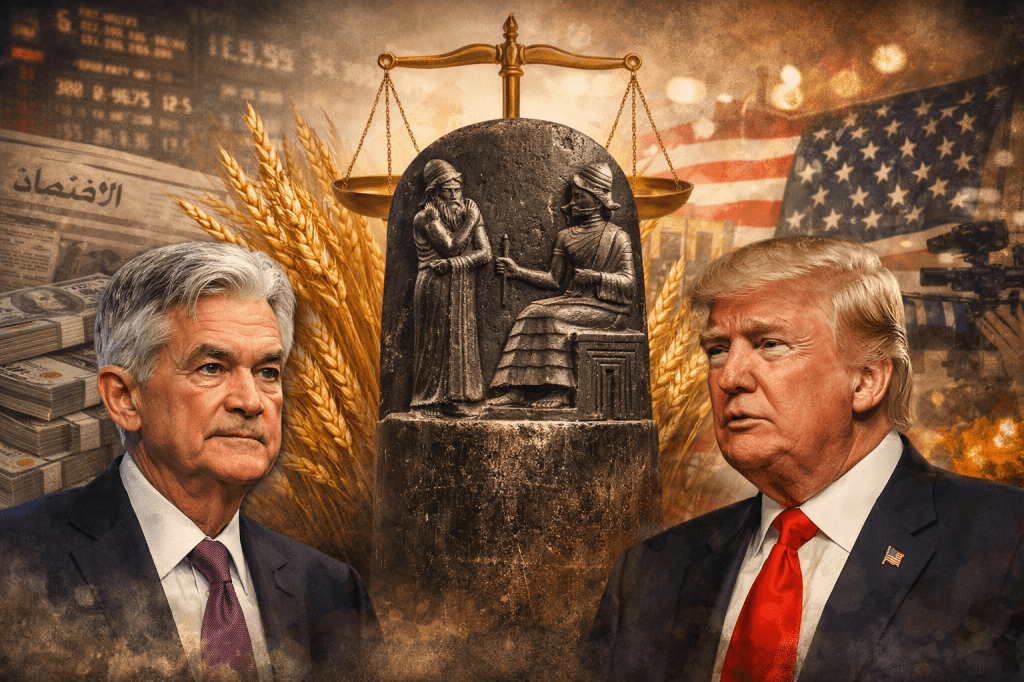
The story of interest rates began unintentionally with Hammurabi, without any aim to establish their modern concept. He was trying to solve a problem that seemed simple on the surface yet dangerous in effect. Farmers needed grain before harvest season, merchants needed money before caravans returned, and others had surplus but feared it would not come back. Without clear rules, disputes were inevitable delayed repayment, denial, and sometimes exploitation. The solution was practical, not philosophical, whoever takes today returns more tomorrow. The increase was not profit as much as recognition that time carries risk and waiting has a cost. This custom traveled with caravans, shifted from grain to silver, and evolved from verbal agreement into accepted practice. When it reached Europe, it did not arrive as law but as necessity. Trade expanded, journeys lengthened, and risks multiplied. There, family banking houses most notably the Medici family transformed custom into system, linking the increase to risk rather than whim. From Florence, the rule spread across European cities, crossed continents, and became a global language for organizing lending. The surprise is that interest did not spread because it was ideal, but because it convinced people to lend their money without fear of losing it.
For most people, knowing the interest rate does not change their immediate behavior, nor does it enter their daily decisions. Those who neither borrow nor invest will not recalculate their lives because a number was announced at a press conference. Yet interest rates are announced to everyone, not because everyone is expected to react, but because they form the foundation of unseen relationships loan pricing, bank obligations, and the protection of depositors’ funds. Transparency here is not a call to action, but a declaration of the conditions under which the financial system operates. Such announcements may sometimes turn into political or media material, but their core purpose is far simpler: that people’s money is neither lent, traded, nor risk-priced in secrecy.
In practice, interest rates do not operate in isolation. They often enter into tension with fiscal policy itself. Fiscal policy, simply put, is the government’s decisions on spending, expenditure, and taxation, while monetary policy controls the cost of money. This is why scenes sometimes appeared as personal conflict, such as those between Donald Trump and Jerome Powell. In reality, Trump was not a rival to Powell as a head of state, but as the leader of fiscal policy expanding spending and pressing the economy from one side, while expecting monetary policy to align. Powell, on the other hand, was not opposing a person, but protecting the independence of monetary policy and controlling inflation. Trump could not dismiss him because the central bank is independent, so he used another tool spending as an indirect pressure mechanism. Here the hidden picture becomes clear: when fiscal policy moves forcefully, monetary policy is compelled to respond, not out of submission, but in defense of balance. The problem does not arise when tools differ, but when all are pulled in the same direction. Fiscal expansion with low interest rates can ignite inflation, while fiscal tightening with high interest rates can suffocate the economy. In the end, this is not about individuals, but about harmony among tools. Those who fail to see this imagine a battle of chairs, when it is in fact a battle of rhythm.
And after thousands of years, the world continues to change numbers and rename concepts yet always returns to the same idea. When money is clear, disputes decline and society calms. From the grain of Babylon to decisions of central banks, the lesson has remained simple: clarity is the oldest monetary policy known to humanity.
Saif Al Nuaimi
Financial Analyst
 Saif AL Nuaimi
أضف تعليق