
9 January 2026
In February 1995, one of Britain’s oldest banks collapsed within days. Barings Bank, with a history spanning more than two centuries, fell after losses exceeding $1.3 billion—not because of a global crisis, but due to decisions made behind trading screens in Singapore. There, a young derivatives trader, Nick Leeson, known for his intelligence and technical skill, was attempting to contain a loss that gradually turned into a catastrophe. As pressure mounted, exhaustion deepened, and acknowledgment of reality was delayed, control was lost. Subsequent investigations did not describe his actions as ignorance or recklessness, but rather as the result of severe mental and psychological fatigue that stripped him of the ability to stop and make the right decision at the critical moment. The story ended with the collapse of an entire bank, becoming a lasting reminder that exhaustion, when left unmanaged, can bring down even the longest-standing institutions.
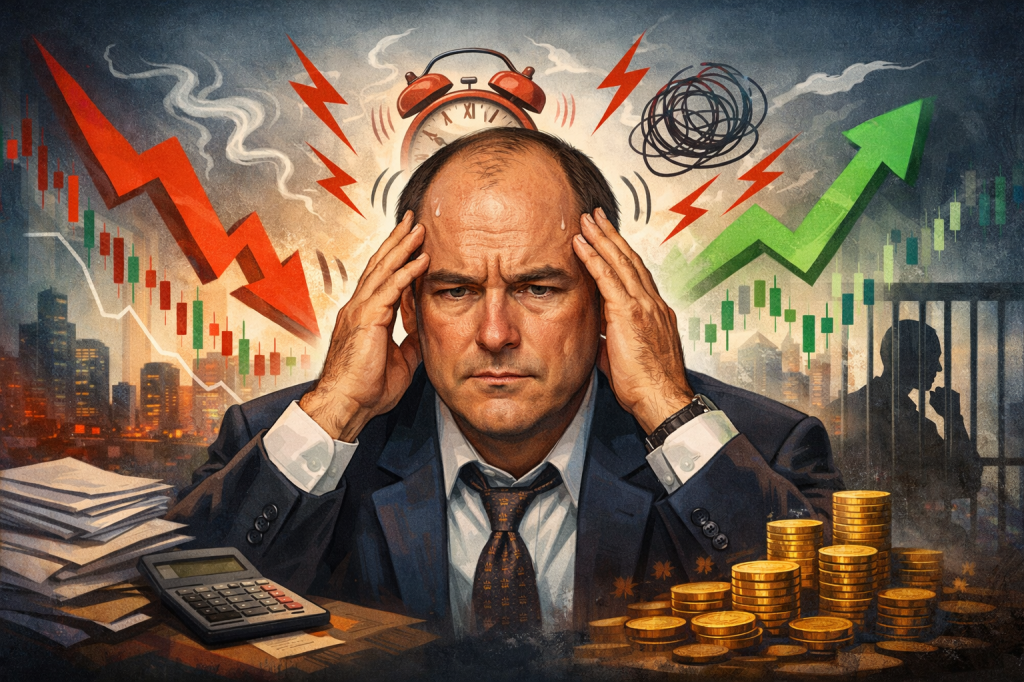
When an investment decision—whether to buy or sell—is made, the mind does not begin with numbers and calculations as commonly believed. It begins with a rapid neurological reaction. The emotional part of the brain moves first, interpreting price movements as either threat or opportunity before rational analysis has time to respond. During sudden market declines, defensive mechanisms are activated, fear is triggered, and the urge to escape takes over. During rapid price rises, the reward system is stimulated, fueling greed and excitement. Both responses occur before any logical evaluation. As these signals intensify, investors enter an internal conflict between decisiveness and fear of error, resulting in hesitation or impulsive action depending on the level of neural pressure. At that moment, the decision is no longer purely analytical but the outcome of a complex interaction between emotion, memory, past experience, and the brain’s ability to control instinctive reactions.
At the moment a decision is taken, the body releases chemical hormones faster than conscious thought. During sharp declines, cortisol and adrenaline surge, causing rapid heart rate, chest tightness, and narrowed focus. The mind shifts from analysis to self-protection, making escape the primary goal. During rapid market rises, dopamine is released, creating feelings of pleasure and overconfidence while dulling risk perception, pushing investors to enter or increase positions without proper evaluation. Under sustained pressure, these hormones overlap, weakening rational control and turning decisions into physical reactions aimed at stopping pain or chasing reward rather than calmly reading the market.
No one welcomes the release of cortisol. It is the hormone of stress and anxiety, and elevated levels place both body and mind in defense mode rather than thinking mode. When cortisol combines with adrenaline and dopamine, internal signals become confused. The investor wants to flee yet hesitates to act, resulting in paralysis or reckless behavior. This hesitation is not conscious caution but a biochemical conflict. This condition is far more pronounced among gamblers, whose behavior is driven by dopamine and instant gratification. When cortisol enters the equation, judgment deteriorates further, and decisions become desperate attempts to stop emotional pain or reclaim the feeling of winning—at any cost.
Throughout all of this, the heart remains innocent. It does not decide, fear, or hesitate. It simply executes the commands it receives from the nervous system. Often, it is the victim. When hormonal surges become extreme, heart rate accelerates, blood pressure rises, and arteries constrict. If the body is already exhausted or burdened by chronic stress, the heart may be unable to withstand the violent physiological response. This is why we often hear of cardiac events following major financial losses—not because the heart participated in the decision, but because it bore the physical weight of an emotional shock beyond its limits.
Here, a fundamental truth becomes clear: investing is not merely a test of intelligence, but a way of life. The investor who maintains good health, exercises regularly, sleeps well, and eats properly provides the mind with a stable environment for sound decision-making. Hormonal balance improves, patience increases, and analysis becomes calmer and more precise. The physically exhausted investor, by contrast, lives in constant neurological volatility, exaggerating fear at times and chasing greed at others. The gambler lacks both physical and psychological discipline, stays up late, eats poorly, and seeks excitement rather than sound judgment. Losses follow—not due to lack of market knowledge, but due to failure to manage the body before managing money.
Nick Leeson’s story ultimately ended in prosecution and imprisonment after his decisions caused losses exceeding the bank’s total capital. He was sentenced to six years in prison, serving four before being released for health reasons. After his release, he left the trading world entirely and settled in Ireland, where he later worked in administrative and organizational roles, engaged in sports, and wrote about his experience, warning of the dangers of stress and exhaustion in finance. In a powerful irony, the man who brought down a centuries-old bank was not a master criminal, but a human being worn down by exhaustion before the markets finished him.
Before you press the buy or sell button, make sure the body making the decision is still holding together.
Saif AL Nuaimi
Financial Analyst
 Saif AL Nuaimi
أضف تعليق